
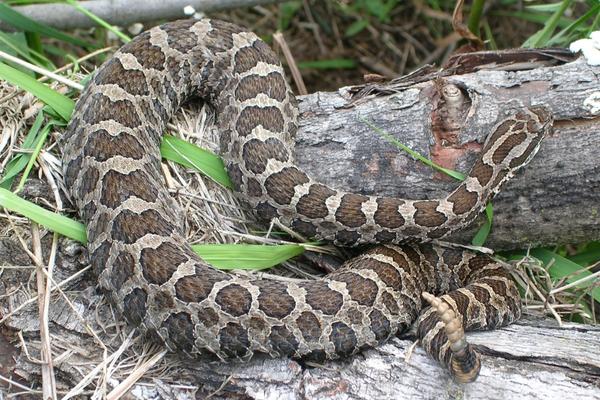
Common name: eastern massasauga, swamp rattler
Scientific name: Sistrurus catenatus

The massasauga is one of the two venomous snakes in Wisconsin. The timber rattlesnake is the other. Some people may imagine massasaugas to be vicious serpents ready to strike, but they are really very shy and secretive
An adult massasauga is two to three feet in length, while an adult timber rattler is usually longer than three feet. The massasauga has chocolate brown "saddles" and triple rows of brownish-black side patches which merge with a marbled dark gray or black belly. Body patches appear edged in black. The tail has five to seven dark rings and is tipped by a grayish-yellow rattle. The head is flattened and broad with one white and three dark stripes radiating from it’s face. Nine enlarged plate scales helmet its head. The timber rattler lacks these large plates and has only small random shaped head scales.
The infamous rattles are actually modified scales with a bony core. Each time the snake sheds its skin a new "button" is added to the rattle, therefore these rattles do not tell the snake's age, but the amount of times the animal has shed its skin. Massasaugas can shed their skin between 3 and 5 times a year, depending on their health and growth rate. The rattles are believed to serve as warning signals to predators. The rattle produces a buzzing sound similar to that of a grasshopper or cricket.
"Massasauga" means "great river mouth" in Chippewa, so named because they are usually found in river bottom prairies, forests, and lowland places along rivers, lakes, and marshes.
Massasaugas do not hibernate in a group like other snake species. Instead, they look for crayfish or mammal burrows, sawdust piles, or old root canals to hibernate alone at or near water level. Crayfish burrows, which are built in river bottoms with mud chimneys, are the favorite hang outs for most massasaugas. Since massasaugas cannot make their own burrows, they depend on these other animals for survival.
Massasaugas get out and about on warm, humid, overcast days to sun themselves. Usually they are coiled motionless in vegetation that hides them. They are usually shy, secretive animals which rely on their camouflage coloration to avoid predators.
Wisconsin is right in the middle of the massasaugas' range, running from central New York and southern Ontario to Iowa and Missouri. In the past, massasaugas were found across the southern half of Wisconsin.
Breeding happens in the spring and the fall. Eight to 20 young are usually born in late August. Massasaugas are ovoviviparous, which means that the young are born live rather than from an external egg. They have an egg tooth that doesn't work, which means that they may have evolved from egg layers.
The newborn snakes are about the thickness of a lead pencil and could wrap around a silver dollar. They are typically born under a log, wood pile, or in abandoned mammal burrows. They stay inside the "nest" for about 4 or 5 days while they shed their skin the first of many times. They "molt" to replace the skin they are born with because the old skin has been stretched and aged from rapid growth of the developing young. The new skin will allow protection and growth until it becomes too stretched and worn.
Massasaugas mature in 2-3 years and can live up to 14 years.
The massasauga is a "pit viper." They were given this name because of the heat sensitive pits they have under each eye which alert the snake to prey. They also eat cold-blooded prey, such as frogs and other snakes, but they are usually hungry for warm-blooded prey like mice and voles.
Rattlesnakes attack their prey by striking. They strike to inject toxic venom into the blood stream. A three foot snake can strike about 12 inches or about one-third of its body size. The fangs of a massasauga are hollow and the venom is secreted into them by glands. Rattlesnakes can control the injection of venom and sometimes don't use it when they bite because of self defense, possibly saving it only for prey. When they are not in use, the fangs rotate and fold backward against the roof of its mouth. Massasaugas have the control to move each fang separately as they desire.
Massasaugas are preyed upon by raccoons, hogs, skunks, foxes, hawks, and eagles.
Massasaugas are endangered in Wisconsin for many reasons.
- Old records show that thousands of massasaugas were killed back in the late 1800s as the city of Milwaukee grew.
- Believe it or not, until 1975 there was a bounty (a fee paid to people who kill "pest" species) in Wisconsin on rattlesnakes. People were paid up to 5 dollars for each rattlesnake tail. In 1975, the bounty was lifted and the massasauga was placed on the Wisconsin Endangered and Threatened Species List. Some people were afraid that protection of the snake would allow them to multiply out of control. However, the number of snakes killed for bounty might have hurt the populations permanently in some areas of the state.
- The draining and dredging of many wetland areas has destroyed much of the habitat that massasaugas depend on.
- Massasaugas are also captured illegally for pets.
Today massasaugas are found only in several isolated localities in southeastern, central, and west central Wisconsin. They are endangered, and without management and added protection this species could be lost in Wisconsin and throughout its range. In 2016, the U.S. Fish & Wildlife Service listed the massasauga as a Federally Threatened Species.
Rattlesnake bites
Since 1900, no one in the state of Wisconsin has died from a massasauga bite. Drop for drop, the massasauga’s venom is more toxic than the timber rattler, but because of the smaller volume of venom, a bite would probably not cause severe harm to an adult human. Very few large domestic animals have ever been killed by rattlesnake bites and hogs are usually unharmed because of their layers of fat. Hogs are an efficient predator of rattlesnakes and have decreased snake numbers ever since hogs were brought to Wisconsin.
The best thing to remember is that if you don’t bother the massasauga, it generally won’t bother you. By wearing hiking boots and staying on the trail you can greatly reduce your chance of being bitten. If you are bitten, knowing first aid and staying calm will help you lessen the effects of the bite.