

Common name: snow flea, springtail
Scientific name: Hypogastrura nivicola
Have you ever seen a snow flea? Have you looked? They are tiny and unique and right under our noses.
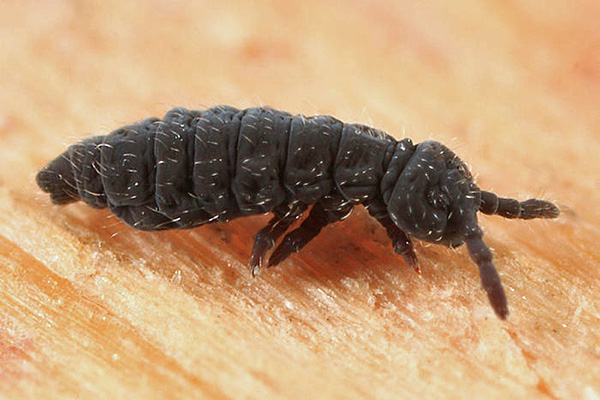
How to identify them
Like insects, snow fleas are arthropods. Their bodies are divided into three parts (head, thorax, and abdomen). They also have antennae and six legs. But they are not insects. They are primitive creatures, having survived the dinosaurs! They are hexapods in the Class Collembola (kol-LEM-bo-la) or springtails. They measure about 1/8 inch (2mm) long.
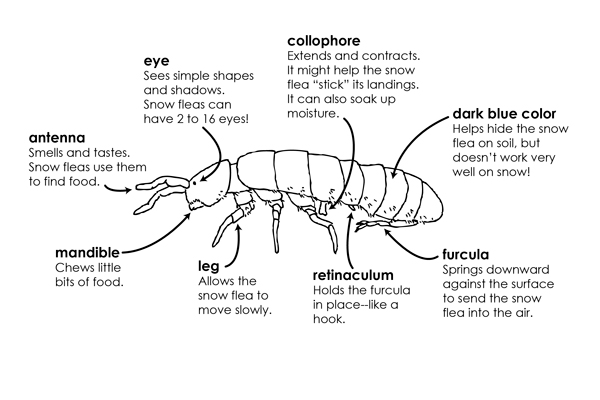
Most springtails have a spring! It works almost like a catapult, allowing them to escape danger. A furcula, which looks like a forked tail, is held in place by a hook, called a retinaculum. When the springtail needs to move, it releases the hook, and the spring-loaded furcula hits the surface and sends them flying into the air. You can see how this works by carefully placing a loaded mousetrap upside-down. Use a stick to touch the back of the mousetrap. The pressure will release the hook, and the trap will go flying randomly into the air—just like a springtail!
Where to find them
On a warm, sunny winter day, look at the bases of trees where the snow has melted, exposing soil or leaves. Watch for tiny specks moving around. Snow fleas look like black pepper sprinkled on the snow and leaves. Each speck you see is a snow flea! If you don’t find them, don’t give up. Try again on a different day or in a different woods.
The rest of the year, they hang out in leaf litter, under loose tree bark, or in the soil.
What they eat
Snow fleas are important decomposers. They eat decayed plant material, algae, bacteria, fungi, and sap oozing from the tree.
Who eats them
Little critters have little predators! Small flies, tiny spiders, teeny beetles, miniscule wasps, and even pseudoscorpions find them just about the right size.
How they reproduce
When you see them on the snow, they may be mating. Males place spematophores (little packages containing sperm) on a leaf. The female picks it up places it in her genital opening. She lays her eggs on leaf litter. Later in spring, the young hatch. They are pinkish and less than a millimeter in length.
Did you know?
There are about 350 species of springtails in North America! Some springtails live in the leaf litter stuck to the underside of leaves or on the surface of the soil or even under the soil. Semi-aquatic springtails live on the surfaces of ponds. You'll have to look very closely to see them because they blend in well and are so tiny. You might even find springtails on your lawn and in your flowerpots!
Snow fleas have a unique protein that works like antifreeze in their bodies. Because this protein decomposes when the temperature rises, scientists are researching whether it could help in human organ transplant surgeries. Could the protein preserve the organ at a lower temperature before surgery then decompose as the patient warmed up after surgery? There are still so many things that we do not know. Will you be the scientist that helps to answer this question?
Check this out
This video was filmed in England for the BBC so the springtails shown here are different species than we have in Wisconsin. But there is great footage of springtails showing off their jumping skills! We’re not sure if our Wisconsin snow fleas use their collophore like the springtails in this video. Could you find that out?