
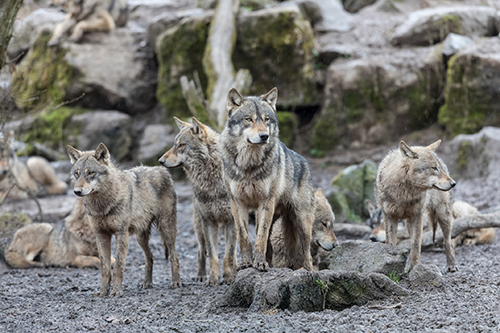
Common name: timber wolf, gray wolf
Scientific name: Canis lupis
Federal Status: Endangered in the lower 48 states. There are two exceptions: the wolves in the Northern Rocky Mountain population are excluded and wolves in Minnesota are listed as threatened.
How to identify wolves
Gray wolves are mostly gray! But they can also be brownish gray, black, or almost white. Their bellies are light gray. Wolves are Wisconsin’s largest member of the dog family. Males are larger than females.
- Length – 53 to 67 inches.
- Height (measured from base of paws to shoulder) – 24 to 36 inches
- Weight – 50 to 100 pounds
- Tail – 15 to 19 inches long
- Ears – round and short
- Muzzle – large and block-shaped
- Feet – big!
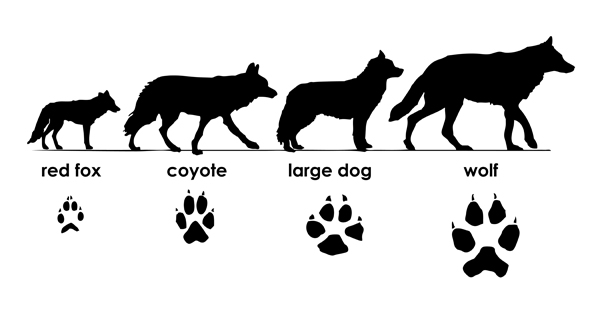
How to recognize wolf tracks
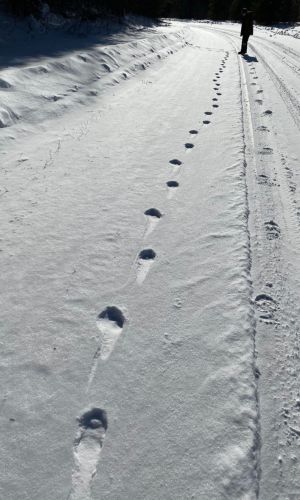
If you think you might have found a wolf track, here are some things that you can ask yourself.
- Do wolves live in this area?
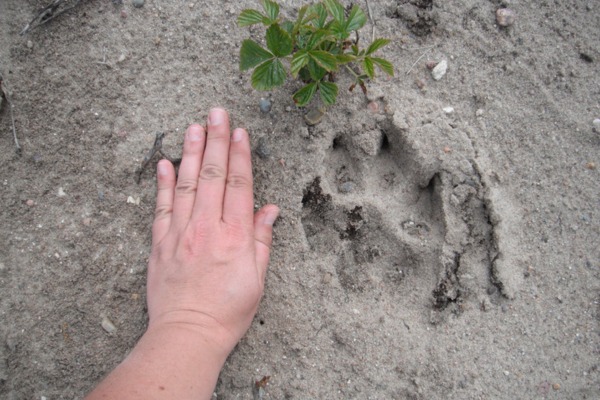
- Is the track big enough? Wolves have big feet! Their tracks are at least 4” long or longer. By comparison, coyote tracks are usually less than 3” long. Even large dogs do not have feet as big as a wolf. Cougars have big feet, but their tracks are more rounded, and they don’t usually show claw marks.
- Are the tracks in a straight line? Wolves can’t afford to waste energy. When they travel, they move in straight or nearly straight lines. Dogs tend to wander around.
You can also find wolves with your ears. You can hear wolves howling from miles away. Howls keep pack members together. If you hear their growls or barks, you are too close!
Listen in on these recordings of wolves.
Where they live
Wolves live in wilderness areas as far away from people as possible. In Wisconsin, they live in forested areas in the north and central parts of the state.
Wolves live together in family groups called packs, usually 2 to 12 wolves. Each wolf pack needs about 20 to 100 square miles of territory in which to find water, food, shelter, and denning areas. Wolves defend these territories from other wolves by scent marking and by howling. Just like some people mark the edges of their property with signs and fence posts, many animals mark their territory, only they do it by urinating and defecating.
What they eat
Wolves in Wisconsin eat whitetail deer, beaver, snowshoe hares, rabbits, squirrels, muskrats, and other smaller animals. During the summer, they also eat fruits and berries.
Wolves hunt in packs of related wolves, including the alpha male and female along with their young. When they capture a deer, they really chow down! The alpha male and female eat first, followed by the rest. They can eat up to 20 pounds of food at one time.
How they reproduce
Even though wolves are ready to mate when they are about two years old, most don’t. Only the alpha male and female in a pack mate. They mate in January to April, and the female gives birth to 4 to 8 pups about 60 days later. The young are blind and deaf when they are born.
The mother wolf keeps the pups in a den for the first three weeks. By this time, they are ready to get out and play. Over the summer, they become more independent and switch from nursing milk from their mother to eating food regurgitated by members of the pack. By fall, they are ready to learn how to hunt with the pack. Gray wolves usually live five to six years, but they can live to be much older.
Did you know?
Biologists capture adult wolves and put special radio collars around their necks. The radios help biologists follow the wolves and locate the packs' home sites. During the summer, under cover of darkness, biologists howl near these home sites to learn whether pups are hidden there. Biologists listen carefully to the returned howls because pups howl at a different pitch than adults. In winter, when there is snow on the ground and no leaves on trees, biologists can count how many wolves are in each pack. Check out some photos from winter wolf surveys. They count the tracks in the snow or count the animals from an airplane. Tracking also helps biologists learn more about the wolves' territories.
You can see some wolves and watch biologists track wolves from the ground and the air in this wolf tracking video.