

Common names: Canada lynx, bizhiw (Ojibwe), le chat (French)
Scientific name: Lynx canadensis
Status in United States: threatened
Status in Wisconsin: Lynx are a protected wild animal in Wisconsin. They were removed from the state's endangered and threatened species list in 1997.
How to identify a Canada lynx
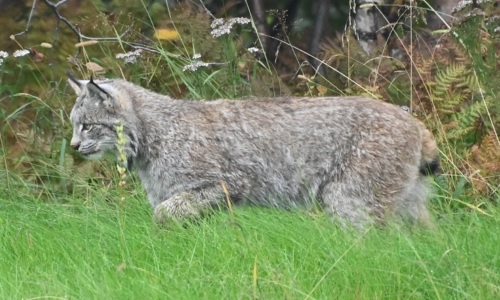
Lynx are medium-sized cats with short tails and long legs. Lynx are often confused with bobcats, but there are differences. The lynx has longer ear tufts that are usually longer than one inch. Their tails are gray with a black tip, while a bobcat's tail has narrow black bands and a black tip. Both lynx and bobcats have back legs that are longer than their front legs. This helps them spring to catch prey.
How to identify a lynx track
If you find a track that looks like an extremely large house cat with very furry feet, you might have found a lynx track. All cat tracks are somewhat round with four toes. Lynx have very furry feet so the outline of the track will look fuzzy. The fur will also make the track look bigger than the cat’s foot actually is. A lynx footprint is 3.5 to 5.5 inches in diameter. In winter, the large, broad paws act like snowshoes, allowing them to walk on the surface of the snow. This gives them an advantage when chasing prey in deep snow.
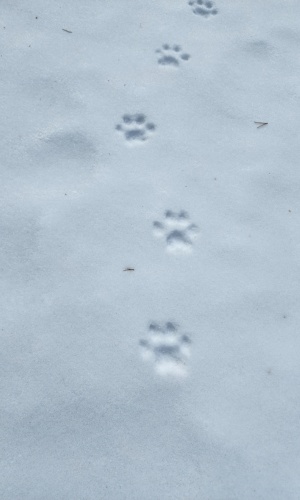
When lynx walk, they usually walk in a fairly straight line. They place their back paws into the tracks that their front paws just made. It looks like the animal only has two legs!
If you follow the tracks, you might find places where the lynx bounded through the snow. Cats can retract their claws, so their claws do not usually show in their tracks. If the snow is deep or packed down, they might extend their claws to get more traction.
Like other cats, lynx cover their urine and droppings with soil or snow. If you are extremely lucky, you might find where the lynx captured, killed, and ate its prey.
Where they live
Canada lynx live in the boreal forests of Canada and Alaska. The distribution of the Canada lynx closely follows the distribution of its main food--the snowshoe hare.
What they eat
Lynx mainly eat snowshoe hares. They will eat other small animals like squirrels, voles, and some birds like grouse. Lynx are not fast runners. The cats rely more on stealth than speed for capturing prey. They will ambush prey from a hidden spot next to a well-used animal trail. Biologists estimate that for every animal a lynx captures, it misses ten. On average, a lynx kills every other night, eating 150-200 hares a year.
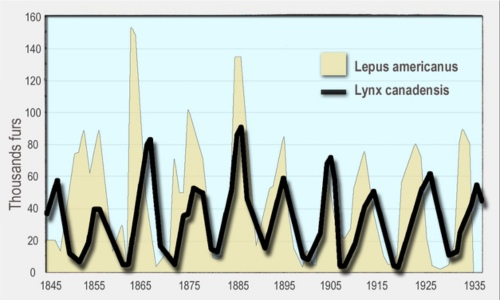
Lynx populations rise and fall in response to the periodic "boom and bust" population cycles of snowshoe hares. When there are a lot of hares, more lynx survive to reproduce so their numbers increase. What do you predict will happen to the lynx population when the hare population crashes? Without as much food, many lynx die of starvation. Others migrate to new areas looking for food.
How they reproduce
Once lynx have mated in late January or February, the male and female go their separate ways. The male takes no part in rearing young. About 60 days after mating, the female gives birth to 1-4 young, called kits. The den is in a hollow tree, log, or brush pile. The kits are blind until 8-10 days-old. Their fur is spotted, but the spots disappear when they shed their newborn coat later in the spring. The female travels with her young until mid-winter, then she drives them away when the next denning season comes around.
Did you know?
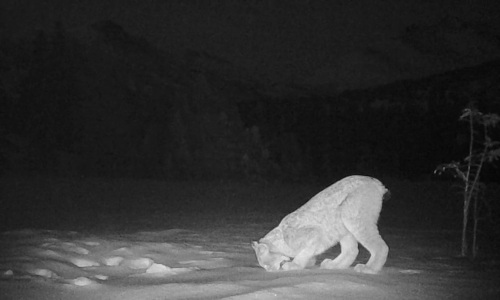
You'll probably never see a lynx in the wild. They occasionally wander into Wisconsin, but they are extremely rare and pretty secretive. They travel alone at night and avoid people. Occasionally, a trail camera catches a lynx that wanders south, but this trail camera photo is from Alaska.
Lynx have never been common in Wisconsin. At one time there probably was a breeding population, but the number declined as trappers caught lynx for the fur trade and loggers and settlers cut down the northern forests. Around this same time, people were prejudiced against predators and a state-financed bounty encouraged the killing of lynx for money. By the early 1900s, lynx no longer bred in Wisconsin.
Since 1900, lynx sightings in Wisconsin have occurred when the 10-year cycle of snowshoe hares in Canada has crashed. When this happens the cats have to wander farther to find food, sometimes moving from Canada to Wisconsin via Minnesota. Biologists don't think that lynx are breeding in Wisconsin, so all the sightings are probably just visitors, not residents.