

Common name: ambush bug, jagged ambush bug, Popeye bug
Scientific name: Phymata sp. (Wisconsin’s two species – Jagged Ambush bug (Phymata americana) and Pennsylvania ambush bug (Phymata pensylvanica) look almost identical.)
How to identify them
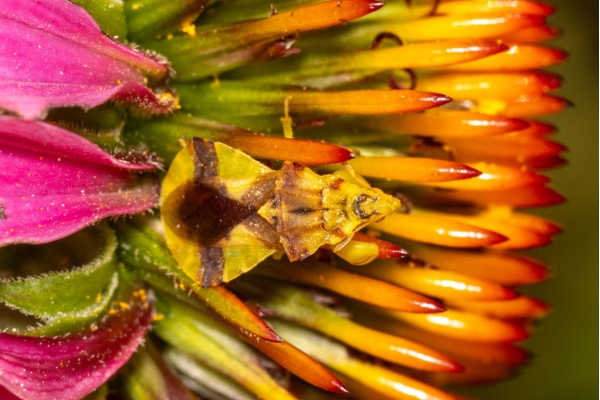
Up close, ambush bugs look like something that crawled out of a horror movie. They are greenish, yellowish, or whitish with darker patches. Their jagged bodies and color patterns help them hide in flowers.
Ambush bugs are true bugs in the order Hemiptera (half-wing). They do have wings, but they can’t fly very well. Adult female ambush bugs are about ½” long with dark markings on their backs. Males are a little smaller than females, and their backs are darker.
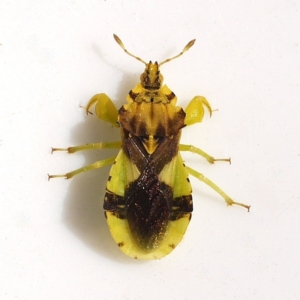
Take a look at the front pair of legs! The legs are swollen with muscles and equipped with claws. Do you see why some people call them Popeye Bugs?
Where they live
Start looking for ambush bugs in July when flowers are in full bloom. You will find them in grasslands, prairies, and gardens. They are native to North and Central America.
What they eat
What they eat isn’t as interesting as HOW they eat. Ambush bugs eat bees, wasps, flies, moths, beetle larvae, aphids, caterpillars, and other soft-bodied insects that visit flowers. They can capture insects like butterflies and bumblebees that are much bigger than they are.
While some predators chase down their prey, ambush bugs sit and wait without moving for hours or days. They perch on their back legs. Their front two pairs of legs are free to grab prey.
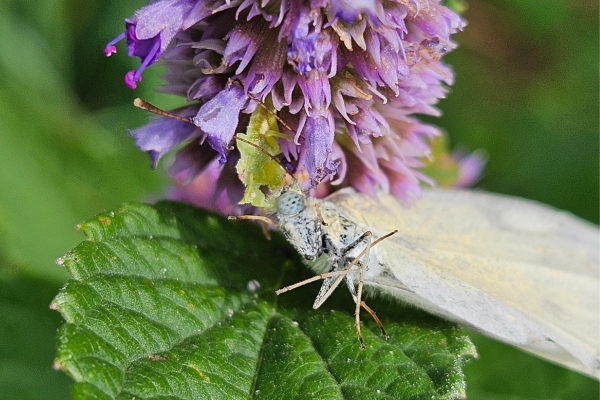
Once an ambush bug captures its prey, it inserts its beak into the prey’s body and injects saliva. The saliva paralyzes the prey and dissolves its internal organs. Ambush bugs use their beaks like a straw to suck out the liquid nutrients -- just like drinking “insect soup.” All that is left of the prey is an empty exoskeleton.
Who eats them
Spiders, birds, and larger insects eat ambush bugs. Could you create a food web that shows life and death on the top of a flower?
How they reproduce
Males search for females. When they find a female, they use creaking and chirping sounds to stay in touch with her. The male may also guard her from other males. Sometimes you will see a female with a smaller male riding on her back.
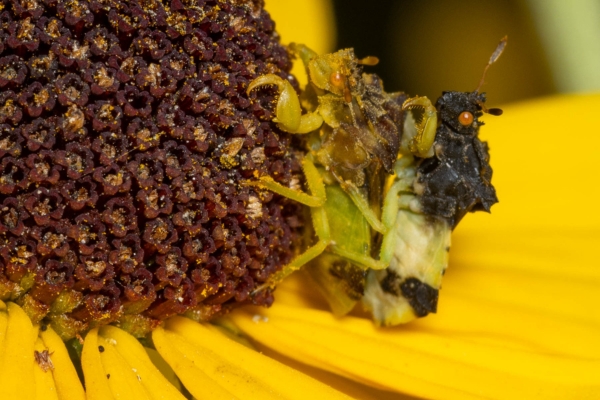
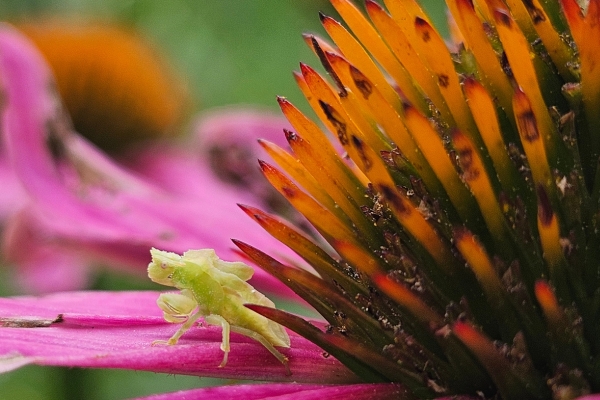
After mating, the female lays eggs on stems and leaves. The ambush bug nymphs hatch out of the eggs. The young that hatch out look similar to adults, but they do not have wings or camouflage coloring. They grow up through incomplete metamorphosis like grasshoppers. After four molts, they are adults with wings.
Did you know?
Watch, don’t touch! That piercing mouthpart can pierce you, too! The paralyzing saliva hurts!
The colors of ambush bugs often closely match the colors of the flowers where they wait. Do ambush bugs choose flowers that match their colors, or can they change their colors to match the flowers?
Ambush bugs can produce sounds to attract prey. Matija Gogala, a Slovenian entomologist, has “talked” with one species of ambush bug through sounds and whistles.