
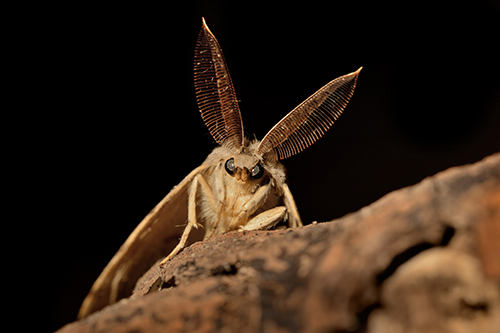
Common name: spongy moth (formerly gypsy moth)
Scientific name: Lymantria dispar
Homeland (origination): Europe, Asia and North Africa. In its native range, spongy moths can be found from the frigid Russian Steppes to the subtropical shores of the Mediterranean where parasites and diseases keep it in balance with its environment.
Arrival date: The spongy moth was brought to North America by Professor L. Trouvelot when he tried to breed a hardy silkworm. Between 1868 and 1869, some spongy moths escaped when a specimen jar fell from Trouvelot's open window. Later, more moths and caterpillars escaped from small populations growing on shrubs in Trouvelot's garden when high winds blew off protective netting. The professor notified townspeople about the accidents, but nobody thought the spongy moth was a pest and no one captured or destroyed the escaped insects. The insects soon multiplied in a vacant lot next to Trouvelot's home in Medford, Massachusetts.
The insects gradually increased their numbers and spread across the United States. Click here to see how fast they spread. They arrived in eastern counties of Wisconsin by the 1990s.
How to identify: Look for the spongy moth in its many forms (stages of life).
Changing faces of the spongy moth
The spongy moth has four distinct stages in life: egg, larva, pupa, and adult. Pick a stage of its life cycle below and click on it to see a picture and to learn more about it. Then, take the Moth Mania Quiz and test your knowledge.

The female spongy moth lays between 500 to 1,000 eggs in August. They are laid all at once in a mass that is covered with velvety, buff-colored hair from the female moth's body. The larvae start developing during the remaining warm days of summer. As winter approaches, the tiny larvae go into diapause. That means they shut down and survive winter without growing or developing until spring. The eggs hatch in mid-May, just in time to start munching on new green leaves.
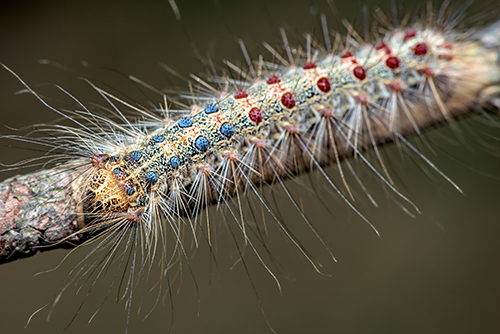
This stage is also known as caterpillar, the worm-like form of an insect. The larva is covered in long, stiff hairs. When it is very young, it's black. As the larva grows, pairs of colored warts appear running down the center of its back. The warts are red on the rear half and blue near the head.
Before the larvae settle down to feed, they will spread out through the forest by "ballooning." This means that the larva climbs to the top of the tree, spins a thread and dangles from it. When a breeze catches the larva, away it goes, usually landing within 150 yards of where it started. Although, on occasion, the larvae are blown long distances. This is one way the spongy moth travels to new areas.
In order to grow, the larva must shed its skin. Spongy moth caterpillars will shed their skin 4-5 times, about once a week. It is the larval stage of the moth that causes all the damage to trees as the caterpillars feed on leaves. By July, the larvae have reached maturity.
When the spongy moth population explodes, the feeding larvae can strip trees of leaves. This is called defoliation. Defoliation is very stressful for trees and can leave them so weak that they can be killed by other pests which would not normally bother them. The hungry larvae feed on many types of trees, but they do have their favorites. These are the ones defoliated most frequently.
Yummy and delicious!
Favorite foods they can't get enough of:
- alder
- apple
- aspen
- birch
- basswood
- hawthorn
- white birch
- tamarack
- oak
- witch hazel
Yuck!
what they won't eat (even if they're starving!):
- green, white and black ash
- red cedar
- scotch pine
- dogwood

This is the metamorphic stage. Within the pupal shell, the caterpillar's body is rearranging itself into an adult moth. The outer skin is reddish-brown and may be attached by several silk threads to a tree trunk, rock, or board, hiding itself from predators.
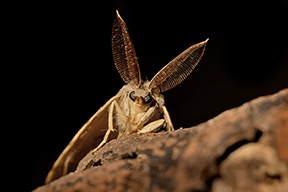
This is the adult stage of the insect. The male spongy moth is about one inch long and has brown wings with black, wavy markings. The antennae are large and shaped like a feather. The female is larger, about 1 ½ inches long. Her wings are white with black markings. Her body is covered in brownish-yellow "fur" and her antennae are thin. She has wings, but can't fly! From late July to early August, the spongy moth will mate and the female will lay eggs. The adults die after mating.
Evidence they are here: When spongy moths have an "outbreak," the caterpillars defoliate trees (eat all the leaves). This typically occurs in mid-June. All leaves on an oak tree can be eaten within a week!
Note: Most trees can grow a replacement set of leaves ("refoliate") by late July, and the forest will be green again. This is very stressful for a tree and can kill the buds, twigs and/or branches. After that, tree growth slows down for several years and the tree can be attacked by other forest insects and diseases. Trees weakened by defoliation will also stop making nuts, sometimes for years, and wildlife lose out on a food source that they depend on. While the trees are bare, predators can easily find nests and songbirds may lose their young. Lack of shade from the tree makes water temperatures warmer, which lowers the amount of oxygen in the water for aquatic plants and animals. A dense canopy of leaves also buffers the violence of summer storms. When that protection is lost, rainwater erodes the soil and lowers water quality in streams. Fish and other aquatic animals can be stressed during this period before trees "releaf." These are all signs that the spongy moth has struck an area.
Invaded territory: Spongy moths spread quickly across the U.S. because the climate was more suitable here and natural predators were few. The Medford area experienced a spongy moth outbreak in 1889, 20 years after the moths were released. Caterpillars defoliated fruit and shade trees in a 360-square-mile area around the city. Local people said they were overrun "by big, hairy caterpillars, so numerous that people slipped on masses of them clustered on the ground, streets and sidewalks" and as "they gobbled away in the trees, their droppings (called frass), like a shower of coffee grounds, drizzled to the ground below." Yuck.
Today, spongy moths can be found across the eastern United States and here at home. By 1989, they had settled along Wisconsin's eastern shore from Milwaukee to Green Bay. Moths have since been found in every county. The eastern two-thirds of the state is considered generally infested and is under quarantine. That means people and business must carefully check things kept outdoors that they want to move. These are things like: plants, wood, furniture, and vehicles. Businesses must check Christmas trees, timber and pulp wood before shipping them on trucks.
Suppression techniques: Although the spongy moth will continue to spread, our trees and forests will survive. Spongy moth outbreaks can be delayed or reduced so that trees and people are less stressed. The most common suppression treatment is a spray of Bacillus thuringiensis, commonly called Bt. This bacterial insecticide kills caterpillars that eat it within a week of spraying. Bt is found naturally in soil and degrades within a week as the sun hits it. Bt does not harm people, animals, birds or fish. Sprays also don't affect spongy moth caterpillars outside the treated area. Sometimes spray programs are repeated for one to three years when the moth population is in the outbreak stage. Once the moth caterpillar population has collapsed in an area, spraying can stop for several years.
Help "Stop the Alien Invasion"! The rapid migration west of the spongy moth in the United States is caused by people unknowingly moving egg masses that are attached to cars, firewood, nursery plants and outdoor furniture. One infestation in Virginia began when an unsuspecting person brought home several dog houses from New Jersey that had spongy moth egg masses on them! Wind can move male moths and young caterpillars, but it doesn't spread the moths rapidly. There are regulations requiring the inspection of logs, nursery plants, Christmas trees, and outdoor household items. These regulations help reduce the number of accidental introductions, but it won't stop them all. We must teach people about these invaders and have them check the trees in their community.
Here's what you can do:
- Check your vehicles and equipment for egg masses before you leave on vacation and again before you return home, so you don't let the spongy moth hitch a ride with you.
- Check your patio furniture, trees and sheltered spots on buildings for egg masses in the fall.
- Give permission to state and federal trappers to place and monitor spongy moth traps on your property.
- Call 1-800-642-MOTH, the Wisconsin Department of Agriculture, Trade and Consumer protection, if you find spongy moths in any life stage in a non-quarantine area..
- Learn more about the spongy moth in Wisconsin. Contact the Wisconsin Department of Agriculture and Consumer Protection, the University of Wisconsin Extension or the Wisconsin Department of Natural Resources - Forestry Program.