
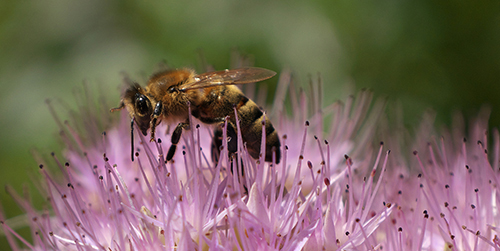
Common name: honey bee, European honey bee, western honey bee
Scientific name: Apis mellifera
How to identify them
Honey bees are a little under one inch long. Their bodies are covered with yellowish hairs. They have black stripes on their abdomens.
Where they live
Honey bees are not native to North America. Early European settlers brought the domesticated bees to America. Now they are naturalized, and they live wherever they can find flowers. Beekeepers construct hives tor bees. In the wild, bees live in hollow trees. You might even find a hive building a honeycomb hanging from a tree branch.
What they eat
Honey bees are vegetarians. They eat:
- Nectar. Worker bees drink nectar because the sugar it contains gives them energy. They carry it back to the hive to feed to other bees and to store in the honey comb.
- Honey. Honey is really just condensed, preserved nectar. Bees eat honey when flowers are not available.
- Pollen. Pollen is full of protein, vitamins, and minerals. Honey bees collect pollen, but they can’t eat it. They use it to make bee bread.
- Bee bread. Honey bees make bee bread by mixing pollen and nectar and allowing it to ferment. Bee bread is eaten by worker bees and fed to larvae.
- Royal jelly. Special worker bees (nurse bees) make royal jelly inside their bodies. They feed it to larvae for the first three days after hatching. Nurse bees continue to feed royal jelly to special larvae. These larvae develop into queens.
Who eats them
Skunks, bears, and raccoons can rip into a hive to eat the honey and the bees. However, the biggest threats facing honey bees are not large predators.
Parasites, such as mites, hive beetles, and lice, can infect and destroy hives. Ants, mice, and other pests can seek shelter in a hive and cause problems. And bacterial, fungal, and viral diseases can cause the death of a hive.
Did you know?
The honey bee is Wisconsin’s State Insect. In 1977, the third grade class of Holy Family School in Marinette was studying the legislative process. With encouragement from the Wisconsin Honey Producers Association, they asked the Legislature to select the honey bee as the state insect. The news got the school community abuzz. Attempts to get other elementary school students to help choose a state bug by popular ballot failed. The monarch butterfly, dragonfly, ladybug, and mosquito were contenders for the title, but the honey bee won.